Posts

Changeable Hawk-Eagle (Nisaetus cirrhatus)

Image
The  changeable hawk-eagle or crested hawk-eagle is a large  bird of prey . More informal or antiquated English common names include the  marsh hawk-eagle or Indian crested hawk-eagle. It is a typical “hawk-eagle” in that it is an agile forest-dwelling predator and like many such eagles readily varies its prey selection between  birds ,  mammals  or  reptiles  as well as other  vertebrates . The changeable hawk-eagle is a largish but slender eagle. Adult changeable hawk-eagles are typically dark brown above and boldly streaked below with a strong bill, a variably sized, often floppy crest or no crest, rather short wings, a quite long, thinly-barred tail and long feathered legs. In flight, the changeable hawk-eagles is a large raptor with a prominent head, rather short rounded and broad wings, long squarish or rounded tail, but has somewhat slenderer wings and straighter trailing edges than sympatric species of...

Crested Serpent Eagle (Spilornis cheela)

Image
  An Adult Crested Serpent Eagle The C rested Serpent Eagle  is a medium-sized  bird of prey  that is found in forested habitats across  tropical   Asia . Its presence ranges across the  Indian Subcontinent ,  Southeast Asia  and  East Asia. A Juvenile Crested Serpent Eagle  This medium-large, dark brown eagle is broad and has a sturdy built, with rounded wings and a short tail. Its short black and white fan-shaped nuchal crest gives it a thick-necked appearance. The bare facial skin and feet are yellow. The underside is spotted with white and yellowish-brown. In soaring flight, the broad and paddle-shaped wings are held in a shallow V. The tail and underside of the flight  feathers  are black with broad white bars. Young birds show a lot of white on the head. A close up The crested serpent eagle is a  reptile  eater which hunts over forests, often close to wet grassland, for  snakes  and  lizards...

Himalayan BulBul

Image
The  Himalayan bulbul or white-cheeked bulbul, is a species of  songbird  in the  bulbul  family found in Central and South Asia.   The Himalayan bulbul is about 18 cm in length, with a wingspan of 25.5–28 cm and an average weight of 30 g. Its head, throat, and crest are black and white. The back, side, and lengthy tail are brown, the underside is pale yellow. Sexes have similar plumage. The song is a beautiful 4-piece whistle, which resembles an accelerated oriole  whistle.   The species occurs in the northern regions of the Indian subcontinent and some adjoining areas. It is found in and near the Himalayas. They are usually found in forests and shrubland and also comes into gardens and parks. They feed on insects and other small invertebrates, as well as berries, fruits, seeds, buds and nectar.  

Roofus Grasshopper (Gomphocerippus rufus)

Image
  The  rufous grasshopper  is a medium-sized, broad, brown, 'short-horned'  grasshopper  with clubbed antennae that are tipped with a conspicuous white or pale colour. It is fairly large, averaging 14 to 22 mm in length.  It can be encountered from late July through mid-December, usually in dry or slightly moist habitats. The environments in which it typically resides include dry grassland on calcareous soils, sheltered valleys with scrub, and the open borders of forests. It feeds on grasses and various herbaceous plants. It is known for its distinctive courtship song and accompanying display.  The rufous grasshopper is usually found in open land, particularly terrain such as meadows, pastures, and forest edges that feature tall grass. More specifically, it can often be found in chalk grassland. Males range from 14 to 16 mm, while females range from 17 to 22 mm. The coloration is usually shades of brown but features some grey, yellow, an...

Acrida willemsei

Image
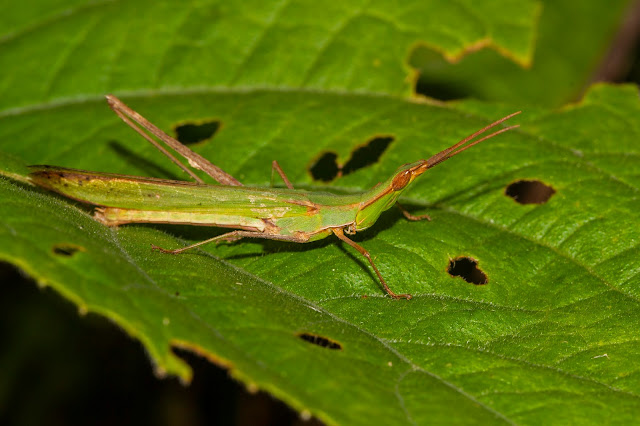
  Acrida willemsei  is an Asian species of  grasshopper . The recorded distribution of this species includes southern China, Taiwan, Indo-China, India, and Malaysia. They are  sometimes called  silent slant-faced grasshoppers.  In appearance, the species are often similar to those of the subfamily Gomphocerinae, with whom they share a slanted face. However, Acrida willemsei differ from Gomphocerinae in that they lack stridulatory pegs on their hind legs and thus, as the common name suggests, do not make sounds. The antennae of this species are flattened and sword-like, a trait also shared with some gomphocerines. They lack the postural spine seen in the spurthroated grasshoppers and lubber grasshoppers (Two different species of grasshoppers that share some common traits). Hind wings in this species are somewhat colorless.  They  aren't particularly selective about what they eat, but they often favor gre...

Scarlet Dragonfly (Crocothemis erythraea)

Image
 Other names -B road scarlet ,  common scarlet-darter ,  scarlet darter The scarlet dragonfly is a common species in  southern Europe  and throughout  Africa . It also occurs across western  Asia  as far as southern  China . Its habitat is a  wide range of both running and standing waters, except those that are shaded. Adults may be found some distance from water in habitats ranging from desert to open woodland; absent from dense forest. They can reach a length of 33–44 millimetres. These dragonflies have a flattened and rather broad abdomen. The adult male scarlet dragonfly has a bright scarlet red, widened  abdomen , with small amber patches at the bases of the hindwings. Also, the veins on the leading edges of the wings are red. Females and immatures are yellow-brown and have a conspicuous pale stripe along the top of the  thorax . It feeds mainly on  water shrews, frogs, predatory insects (including other dragonflies) ...

Lychee Shield Backed Jewel Bug(Chrysocoris stollii)

Image
They are a species of  jewel bugs  common in continental  Southeast Asia . These bugs  are commonly known as  jewel bugs  or  metallic shield bugs  due to their often brilliant coloration.  These  insects  feed on plant juices from a variety of different species, including some commercial crops such as  Pigeon pea ,  Arecanut ,  Jatropha, etc A vast majority of jewel bugs, both adults and nymphs, are also capable of releasing pungent defensive chemicals from glands located on the sides of the thorax. Typical compounds exuded by jewel bugs include alcohols, aldehydes, and esters. Nymphs and adults often exhibit clustering behavior, being found in large numbers close to each other. This behavior is thought to have an evolutionary advantage. The more individuals present in an area, the stronger the odor of the chemicals released when the bugs are threatened. If this fails, stink bugs w...

Yellow Waxtail(Ceriagrion coromandelianum)

Image
  Yellow Waxtail is a species of  damselfly, i t is commonly known as  coromandel marsh dart . This species can be found in  South Asian  countries such as  India ,  Sri Lanka ,  and  Nepal .  It is a medium-sized damselfly with yellowish-green eyes. Its thorax is olive-green above and yellowish-green on the sides. Its abdomen is yellow. Its anal appendages are citron-yellow or ochreous, the inferiors tipped with black. The superiors are sub-quadrate as seen from above, with the corners gently rounded. The inferiors are sloped strongly upwards, broad at the base, then tapering rapidly to an acute point. Female is more robust and dull colored. Its thorax is more greenish and the abdomen is golden yellow to brown.  It breeds in weedy ponds, ditches, and rice fields. Picture 1 - Male Picture 2 - Female 

Black Francolin

Image
  The   black francolin belongs to  the  pheasant  family . It was formerly known as the Black Partridge. It is the state bird of  Haryana . It is known as Kaala Teetar locally.  The head of the black francolin is curved with brown iris eyes color and unique pattern of brown color crown and the throat color is black. It has a length ranging from 33 to 36 cm and weight approximate about 453 g and the size of black francolin is 9 to 16 inches. The primary color is black with black breast rufous belly, white spots on flanks, and golden brown spots at the back of the body. The flight pattern of the black francolin is short, direct flight punctuated by glides with rounded wings, rounded tail narrow black and white bars. Black francolin male The male black francolin is black with a white patch on the cheek, a chestnut collar, and white spots on the flanks. The back and wings are scalloped with shades of golden brown with sub-terminal tawny-buff bands an...

Scarlet Minivet

Image
  This  minivet  is found in tropical southern  Asia  from  India ,  Sri Lanka  to southern  China ,  Indonesia , and the  Philippines . They are common resident breeding birds in forests and other well-wooded habitats including gardens, especially in  hilly  country. While the male  is scarlet to orange with black upperparts, the females are usually yellow with greyish olive upperparts.  The scarlet minivet is 20–22 cm long with a strong dark  beak  and long wings. The male has black upperparts and head, and  scarlet  underparts, tail edges, rump, and wing patches. The shape and colour of the wing patches and the shade of orange in the male vary across populations.  The female is grey above, with yellow underparts, including the face, tail edges, rump and wing patches. This minivet catches  insects  in trees by flycatching or while perched. It flushes insects out of foliag...

Anomalous Nawab (Charaxes agraria)

Image
 The Anomalous Nawab  is a  butterfly  found in Asia that belongs to the rajahs and nawabs group. It is found mainly in India, Nepal, and Sri-Lanka. Its wingspan ranges from 95-100 mm.  The male and female have wings with the yellow bands uniformly narrower, the outer edge of the band more irregular, undulated, the portions between the medians being each somewhat incurved. This butterfly somewhat resembles the Common Nawab, but it is paler with more acute forewings, light bands on the forewing relatively broader. It has two yellow dots near the forewing's apex.  Its flight is very swift and strong. It is often seen in the company of other butterflies, mudpuddling, or probing for plant sap. It is the most active in the months of March to November.  

Plain Tiger (Danaus chrysippus)

Image
 Plain Tiger, also known as the African Queen and the African Monarch,   is a medium-sized butterfly widespread in  Asia ,  Australia,  and  Africa . It  primarily consume plants  commonly called milkweed. Milkweed contains toxic compounds  that are often consumed and stored by many butterflies. Because of their  emetic  properties, the plain tiger is  unpalatable  to most predators. As a result, the species' coloration is widely  mimicked  by other  species  of  butterflies . The plain tiger inhabits a wide variety of  habitats , although it is less likely to thrive in  jungle -like conditions and is most often found in drier, wide-open areas. Plain Tiger is a medium-sized  butterfly  with a  wingspan  of about 7–8 cm. The body is black with many white spots. The wings are orange, the upperside brighter, and richer than the underside. The upper half of the f...

Dusky Eagle Owl

Image
The  dusky eagle-owl  is an  owl  species that is widespread in  South and  Southeast Asia. The dusky eagle-owl occurs from India, Nepal, and Bangladesh to Myanmar, Thailand, Malaysia. Peninsular Malaysia, it has been recorded in oil palm plantations during surveys carried out between autumn 2009 and 2010 in the states of Selangor, Perak, Pahang, and Negeri Sembilan. Its preferred habitats are wetlands with dense tree cover. The dusky eagle-owl is a large greyish-brown owl with prominent ear tufts. Its underparts are greyish-white with some dark brown streaks, and its dark brown wings have some whitish streaks. It is about 58 cm in size. The dusky eagle-owl is usually active at night and emerges from its roost shortly before sunset. In cloudy weather, it sometimes also hunts during the day. The nesting season is from November to April. The nest is made o...

Brown Fish Owl

Image
  The  brown fish owl is a  fish owl  species in the family known as typical owls. It is native from Turkey to South and Southeast Asia.  It inhabits forests and wooded wetlands. Of the four living species of fish owl, it is the most widely distributed, most common, and best-studied. It occupies a range of over 7,000 km. The brown fish owl is an all-year resident throughout most tropical and subtropical parts of the  Indian Subcontinent to Southeast Asia and adjoining regions. The brown fish owl has prominent ear tufts and rufous-brown upperparts that are heavily streaked with black or dark brown. Its underparts are whitish, with wavy dark brown streaks and finer brown barring. Its throat is white and conspicuously puffed. Its facial disk is indistinct, the bill dark and the  iris golden yellow. Its featherless feet are yellow. Two-year-old brown fish owls are somewhat paler than adults. Females an...

Common Emigrant (Catopsilia pomona)

Image
 Common Emigrant, also known as Lemon Emigrant, is a medium-sized butterfly commonly found in India, Nepal, Bhutan, Sri-Lanka, and Myanmar. Its wingspan ranges from 55-80 mm.  It is a common species of gardens and city areas. Usually seen on flowers in gardens throughout the year. During the summers, due to the scorching heat, they can be found near damp patches. Their flight is rapid with erratic up and down swoops. They are found up to 4000m in the hills.  Both the genders are yellow to translucent greenish-white in color. Their antennae may be red or black in color. 

Common Evening Brown (Melanitis leda)

Image
  The Common Evening Brown is found in India, Nepal, Bhutan, Sri-Lanka, Myanmar, and Bangladesh. Their wingspan ranges from 60-80 mm.  Their flight is jerky and they fly close to the ground. They are found up to 2100m in the hills. They can be found fluttering around throughout the year. They are usually active at dusk and might enter houses since they are attracted to light. These butterflies have two morphs(looks), one is the wet season morph and the other is the dry season morph. During the wet season, they have coffee brown wings with huge yellow, black and white spots. During the dry season, their wings are hazelnut brown in colour and the huge spots fade away and black patches appear on the wings which impart the look of a blotted paper, disguising it as a completely different butterfly. 

Garden tent web spider (Cyrtophora cicatrosa)

Image
 The garden tent web spider belongs to the family of orb weaver spiders.  Although they are in the orb-weaver family, they do not build orb webs. Their tent-like, highly complex non-sticky web is sometimes considered a precursor of the simplified orb web. These webs are aligned horizontally, with a network of supporting threads above them. These spiders often live in colonies. Females have a body length of mostly about 10 millimeters long.  The spider constructs a tent web, about a meter high form the ground. Builds the web in an open environment. Prefers moist and thick surroundings. Hunting method -  The spider rests at the hub or in the retreat. An airborne insect striking the upper barrier web either drops onto the horizontal net or remains entangled in the upper barrier web. The prey produces vibrations in the web upon impact and/or during struggling, and these are transmitted via web elements to the hub. Some discrimination of prey characteristics on the basis ...

Neoscona theisi

Image
  The  Neoscona theisi are a species of spotted orb-weavers. The  females have a body length of up to 11 mm. Males are slightly smaller, measuring up to 9 mm.  They build an  orb web  and rest near the center.  Individuals vary in color from dark reddish-brown to pale-yellow with a distinct pattern on the upper abdomen, lighter along the center-line, and darker on the sides. The legs are light with dark patches at the joints.  They are found from  Cyprus, Israel, Russia, India, Philippines, China to Indonesia, Japan, Australia. They normally feed on smaller bugs, flies, and other insects. It is usually observed that they retreat back to long leaves to rest at noon.  According to me the spider in the above image is a female.   

Nothern Lime Swallowtail (Papilio demoleus)

Image
Other names - Lime Butterfly, Lemon Butterfly, Lime Swallowtail, Chequered Swallowtail. These  common names  refer to their host plants, which are usually citrus species such as the  lime . Unlike most butterflies belonging to the swallowtail family, it does not have a prominent tail. The butterfly is  found from Asia to  Australia and can be easily spotted in gardens. The butterfly has a wingspan 80–100 mm.  Above, the background colour is black. A broad, irregular yellow band is found on the wings above, which is broken in the case of the forewing. Besides this, the butterfly has a large number of irregular spots on the wing. The upper hindwing has a red spot with blue edging around it. This butterfly is an avid  mud-puddler(as explained in the Ceracris post)  and visitor of flowers. It basks with its wings held wide open on tufts of  grass  and  herbs , and generally keeps within a metre of the ground, even on cloudy days. I...

Common Castor (Ariadne merione)

Image
  Common Castor is  an orange  butterfly  with brown lines whose  larvae  feed almost exclusively on the castor oil plant .  Their wingspan ranges between 30–35 mm. Like others in their family , their front two legs are small and unused, effectively making them four-legged. These smaller appendages are covered with long hairs, giving them the characteristic brush look.   It is a very active butterfly but weak on the wing. It flies gracefully as if sailing through the air among the castor plants or any dense vegetation. It is fond of resting on leaves at the top canopy, keeping the wings slowly moving sideways, and always nearer to host plants. It is found all over India, Shimla to Sikkim in The Himalayas, and recorded from Rajputana and Bengal, Assam, Cambodia, Myanmar, Tenasserim, Malayan subregion.